Cox is our decision model: it reads a text and answers typed questions about it (yes or no, a choice among options, a rating on a scale) with a calibrated probability for every option. This article describes how we build and test it, and what the testing has taught us about where improvements come from. A companion article, How Vitund builds and checks training data, covers the data side, including how we keep test texts out of training.
The recipe
Our released model, cox-1-3b, starts from Qwen3.5-4B-Base and keeps the first 20 of its 32 blocks, since we found in Where answers form that the top blocks add little to these answers. On top of that backbone we train a rank-16 LoRA together with a small readout that scores each answer option against the question, the same way for every kind of question. The text comes first and every question about it follows, so one pass over the text answers all of them. We train two seeds and merge them into one model of the same size. The training mix has about 143,000 rows, roughly three quarters of them generated by code or by verified teacher models and a quarter from human-labeled public tasks whose licenses allow commercial use.
How to read the numbers
Two numbers appear throughout this article.
- Skill measures how much better a model does than always guessing the most common answer for a task: 0 means no better than that guess, 1 means always right, and a negative number means worse than the guess. We use it rather than accuracy because accuracy flatters tasks where one answer is common: on a task where 90% of the answers are “no”, a model that always says “no” is 90% accurate but has a skill of 0.
- Calibration error (expected calibration error, or ECE) measures whether the model’s confidence can be taken at face value. We group the model’s answers by how confident it was, compare each group’s average confidence with how often those answers were actually right, and average the gaps, weighted by group size. If the model says 80% and is right 80% of the time, the gap is 0; a calibration error of 0.08 means its stated confidence is off by about 8 percentage points on average. Lower is better, and it matters because anyone automating decisions with Cox decides which answers to trust by their confidence.
A difference in skill of about 0.01 is within the noise of a single training run.
How Cox reads a request
A request to Cox is a text and one or more typed questions about it, each with its options. Three design choices decide how Cox turns that into probabilities, and we benchmarked each one against the alternatives before choosing it.
Reading each option in context
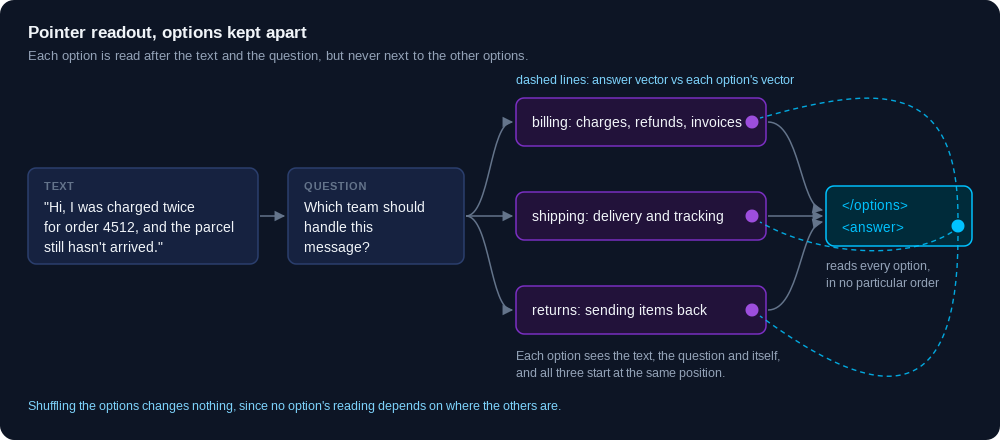
Both readouts we’ve built end each question with an answer position and score the model’s vector there against one vector per option. They differ in how the option’s vector is made. The slot readout encodes each option on its own, as a short phrase with its description, apart from the text. The pointer readout, which Cox uses for every kind of question, reads each option after the text and the question, so the option’s vector reflects what that option means for this particular text. An option is then judged in context rather than as an isolated phrase, which matters most when an option’s name only makes sense alongside the text or when there are many similar options.
The diagram below shows how Cox builds the context for a request: a support message, the question “Which team should handle this message?”, and three options.
We compared the two readouts on the 4B model with the same data and seed (half our usual training length, one run each):
| Slot readout | Pointer readout | What it means | |
|---|---|---|---|
| Tier A skill (calibration error) | +0.491 (0.115) | +0.552 (0.082) | Better on trained kinds of question, and better calibrated. |
| Tier B skill (calibration error) | +0.566 (0.077) | +0.610 (0.067) | Better on kinds of question the model was never trained on. |
| Items whose label is ambiguous | 47.2% | 57.1% | Better when the right answer is a judgment call. |
| Legal clause types, 100 options | +0.368 | +0.574 | The biggest gains are on questions with many options. |
Until build 1.2, yes/no questions were the exception. Tests on a smaller model had found the slot readout better for them, so build 1.1 read yes/no questions with the slot readout and everything else with the pointer. When we re-tested that choice on the 4B model, with two training runs of each recipe, reading a yes/no question with the pointer too, as a choice between “yes” and “no”, came out ahead on both runs:
| Two readouts (build 1.1 recipe) | Pointer for every question (build 1.2 recipe) | What it means | |
|---|---|---|---|
| Tier B skill, run 1 / run 2 | +0.634 / +0.650 | +0.654 / +0.660 | Higher on both runs, on kinds of question the model was never trained on. |
| Tier B calibration error, run 1 / run 2 | 0.089 / 0.090 | 0.071 / 0.079 | Better calibrated on both runs. |
| The two runs merged, 15-task comparison set | +0.648 (0.082) | +0.653 (0.069) | The released build: slightly higher skill, clearly better calibration. |
Build 1.2 uses one readout for every kind of question, and a yes/no question is now simply a choice with two options.
Keeping options and questions apart
When several options or several questions share a context, each one can influence how the model reads the others, so the answer can depend on the order of the options or on which other questions were asked. Cox prevents both.
- Each option is read in its own copy of the context. It sees the text and its question, but never the other options, and all options sit at the same positions. Shuffling the options therefore can’t change the answer. With the slot readout, shuffling flipped between 1.0% and 8.5% of answers depending on the task; with the pointer readout and separate options it flips none, apart from rounding at 16-bit precision. An independent study of decision models found the same property from the outside: restricting Cox’s option list gives answers consistent with the full list (JevCascade, arXiv 2610.07716).
- Each question is answered from its own copy of the text’s state. The model reads the text once, and every question then continues from a copy of that reading, seeing the text and itself but not the other questions. A question’s answer is the same whether it’s asked alone or with nine others, and the text isn’t read again for each question: with ten questions per document, this ran 5.6 times faster than reading the document once per question, in less memory.
Why we don’t use letter codes
Another common design labels the options A, B, C and asks the model for a letter. We tested two versions on a 1.7B model: plain letters, and learned markers that start from the letters’ meaning but are trained for the job.
| Readout (1.7B, one run each) | Tier B skill | Answers changed by shuffling the options | 6-option question types | 77-option banking intents |
|---|---|---|---|---|
| Slot | +0.433 | 6.7% | +0.49 | +0.57 |
| Letter codes | +0.406 | 6.9% | +0.62 | +0.57 |
| Learned markers | +0.420 | 7.4% | +0.50 | +0.63 |
| Pointer, options kept apart | +0.458 | 0.3% | +0.80 | +0.66 |
Letters help on short option lists, where the model’s pretrained habit of answering “A” or “B” gives it a head start, but they carry no meaning of their own on long lists, and neither letters nor markers reduce the effect of option order. The pointer readout with options kept apart did better on every measure in the table, so Cox doesn’t use letter codes.
The letter-code comparison above is from a 1.7B model, and since the yes/no result had shown us that a choice made on a smaller model doesn’t always hold at the size we ship, we repeated it on the 4B model in October, training the same recipe with letter codes instead of the pointer readout:
| Readout (4B, the build 1.2 recipe) | Tier A skill (calibration error) | Tier B skill (calibration error) |
|---|---|---|
| Pointer, options kept apart | +0.663 (0.067) | +0.654 (0.071) |
| Letter codes | +0.635 (0.096) | +0.613 (0.092) |
Letter codes scored 0.027 lower on Tier A and 0.042 lower on Tier B, with intervals well clear of zero, and their confidence was less trustworthy. The Tier B gap is about three times the difference we see between two training runs of the same recipe, so we stopped after one run: the 1.7B result holds at 4B, and Cox keeps the pointer readout.
The test suite
Our main test is a frozen suite of real-text tasks drawn from public datasets, about 1,000 items each, scored as skill with calibration error alongside. We built it with three rules.
- Two tiers. Tier A tasks are kinds of question Cox was trained on, in a new setting: new option sets, new domains, new sources. Tier B tasks are kinds of question it was never trained on (irony, paraphrase, legal clause types and others), and for each one we lock the whole kind out of training, not only the dataset, so Tier B measures skill the model wasn’t taught.
- A dev half and a test half, chosen by a rule. Within each tier, tasks are ordered by a hash of their name and the lower half becomes the development half. We iterate on dev and read the test half once, for publication, and because a hash picked the halves nobody could have picked the easy tasks into either side.
- Questions written once. The questions, instructions and option descriptions were written before any model was scored, and we don’t tune them against results.
Fixing labels without tilting the field
Public datasets carry label errors, and a model that’s often confidently right against a wrong label looks worse than it is, so we review labels. We run the same blind review on the confident errors of every model we compare, with one rule for all, since a review of only our own model’s mistakes would favor our model. Each change to the suite gets a new version, and we keep every earlier version so published numbers stay reproducible.
| Version | What changed |
|---|---|
| v1 | 20 tasks (8 Tier A, 12 Tier B) |
| v1.1 | one comment-moderation task split into three, so rare attributes (threats, identity attacks) have enough positive examples to measure |
| v1.1-clean | a manual label review applied, and one emotion task removed whose labels came from hashtags |
| v1.2 | label review of confidently wrong items, and repeated texts kept once |
| v1.3 | the review extended to the confident errors of every model we compare, with one rule for all |
| v1.4 | two new Tier B tasks (below) |
In the review, two teacher models answer each candidate item blind, and an item both answer against the dataset label is flagged. A person then checks a sample of the flags before anything changes: in the latest round, 30 checked flags showed the moderation relabels right 8 times out of 9 and the others only about half the time, so we relabeled the moderation flags and dropped the rest from scoring rather than trusting the teachers. Every model in our comparisons is scored on the same corrected labels, and when a model’s published training data includes a suite task, ours included, we leave that task out of its comparison and say so.
New tasks the model can’t have seen
In October we decided to train on some customer-shaped kinds of question that had been locked, such as yes/no questions about a passage, which meant Tier B would lose some of its tasks. To keep it meaningful we added two new kinds that customers rarely need: whether a short text contains a pun (SemEval-2017 Task 7, expert labels, only its CC BY items) and whether a text is meant to be funny (HaHackathon, SemEval-2021 Task 7, 20 raters per text). On these, cox-1-3b scores +0.418 on puns and +0.704 on humor. Puns are hard for it: it misses many real puns, as did build 1.1, which gave “‘How long will I have to wait for a table?’ asked Tom without reservation” a pun probability of 0.01, but build 1.2 is no longer sure of itself when it misses one. Build 1.1 was wrong on 11.6% of its answers on these two tasks given at 97% confidence or more, while build 1.2 is wrong on none of its 154 such answers, and its calibration error on puns fell from 0.111 to 0.072, so its pun answers can now be trusted at a high threshold even though it still misses many puns.
Other tests
Alongside the suite we score generated test sets built the same way as our generated training data, including settings held out of training entirely (for example speed and area in our unit-comparison set), a fixed sample of 4,364 requests from the Decision Index benchmark collection, and JevBench. The generated sets tell us whether a kind of skill was learned; the real-text suite and the Decision Index tell us whether it transfers.
We also test whether Cox follows the facts in a text or a conclusion someone states in it. Each test scenario has records and a rule that decide the answer (a warranty period, a refund cap, a dispatch cutoff), and we ask the same question three times: with a note that agrees with the facts, with a note that contradicts them, and with no note. When a question needs arithmetic Cox can’t do reliably, such as a warranty period that ends in a leap-year February, it tends to follow the note, right or wrong; when the rule is a simple threshold, the note makes no difference. We use the gap between the two as a standing measure for every build.
How we decide what to trust
A single training run can move a score on its own, so before we act on a difference we compare it with the variation between runs of the same recipe. Two runs that differ only in their random seed moved our suite’s tier averages by up to 0.024 on a smaller model and individual tasks by up to 0.13, while on the 4B model the Decision Index sample’s average moved by only 0.003 and individual benchmarks by up to 0.084. From those measurements we follow three rules.
- Two runs before a decision. We act on a change only when it shows up on two training runs, and we compare runs on the same test items with a paired bootstrap, which gives a much tighter interval than comparing two averages.
- No conclusions from one task. A single task can move by 0.1 between runs on its own, so we read results as averages over many tasks and treat large moves on one task as noise until a second run repeats them.
- Decide at the size we ship. We still try ideas on smaller models first, since a change that fails clearly there rarely helps at 4B, but results don’t always carry over: cutting a smaller model to two thirds of its blocks cost nothing, while cutting the 4B to half of its blocks cost about 0.03, and the yes/no readout result above reversed at 4B. In October we went back over the experiments behind the current model, about 130 of them, and re-tested at 4B the ones that still shape it, starting with those that need no training (question wording, answer consistency, images, and answers without the text), all of which held or improved at 4B.
What moved the numbers, and what didn’t
Over two weeks in October we tested changes to the model itself, each as a controlled comparison with the same data and seed. The numbers are skill on our 15-task comparison set unless the row says otherwise.
| What we changed | Before | After | What it means |
|---|---|---|---|
| Removed the top 8 of the backbone’s 32 blocks (4B) | +0.648 | +0.651 | Same skill with a quarter less model to run. We kept the cut. |
| Removed 4 more, leaving 20 of 32 blocks (4B) | +0.640 | +0.643 | Same skill again, now with 37% fewer blocks than the full backbone, which is how cox-1-3b is built. Cutting further, to 16 blocks, cost about 0.03, so 20 is where we stopped. |
| A 9B backbone (cut to 24 blocks) instead of the 4B | +0.648 | +0.662 | A small gain for more than twice the size and cost, so not worth it for now. |
| Merged two training runs into one model | +0.640 and +0.651 (two runs) | +0.653 | A small gain. Both builds of cox-1-3b are such merges. |
| One readout for every kind of question (build 1.2) | +0.648, calibration error 0.082 | +0.653, calibration error 0.069 | Better calibrated at about the same skill, so more answers can be automated at a given accuracy. We adopted it. |
| Comparing the answer options against each other at inference | +0.648 | slightly lower | Not worth it. |
Each row compares two models trained the same way apart from the change, but the rows come from comparisons made at different times, some on earlier versions of the comparison set, so compare the before and after within a row rather than numbers across rows.
Cutting the top blocks and moving to one readout are the two changes in the table that we adopted outright: the first made the model smaller and faster without costing skill, which matches what our layer maps showed about where answers form, and the second made its confidence more trustworthy.
Two things moved the numbers more than any change to the model. The first was the wording of the question. When a teacher model rewrote a benchmark’s original question into a precise one, chosen on a development half and scored on a held-out half, the first build of cox-1-3b improved as follows:
| Task | Original question | Rewritten question | What it means |
|---|---|---|---|
| Threats in online comments | +0.715 | +0.811 | A clearer question helped a lot. |
| Hallucinations in RAG answers (RAGTruth) | +0.377 | +0.462 | A clearer question helped a lot. |
| Phishing decisions (PhishNChips) | +0.012 | +0.306 | A large gain, part of it from wording specific to that dataset. |
| Contract clauses vs statements (ContractNLI) | +0.689 | +0.685 | No change: the original question was already clear. |
The second was breadth of data: the strongest models we compare against are trained on far more and more varied data than ours. That’s why our current work is mostly data, for example comparisons across units and number formats (“3 kg is less than 5 pounds”), where cox-1-3b is right about 60% of the time, and questions about whole sets of items in long documents, where it errs most. We judge a data change by whether it transfers to the real-text suite and the Decision Index, not by its own held-out set, since a new kind of training data can teach its own task without helping anything else.
Limitations
Some of the design comparisons in this article are single runs, and some come from smaller models; we’ve re-tested at 4B, with two runs, the ones that shape the released model, and we mark the others as directions rather than settled results. The suite is English, and its label reviews used teacher models we also use to make training data, which is one reason we check their flags by hand before relabeling. Our new Tier B tasks are small (1,000 items each), so differences under a few points between models on them are within noise.
If you’re testing a model of your own on similar tasks, we’d be glad to compare results, and we’re happy to share the suite’s construction recipe and our per-item predictions for the models in our comparisons.